Government Schemes and Subsidies for Animal Husbandry
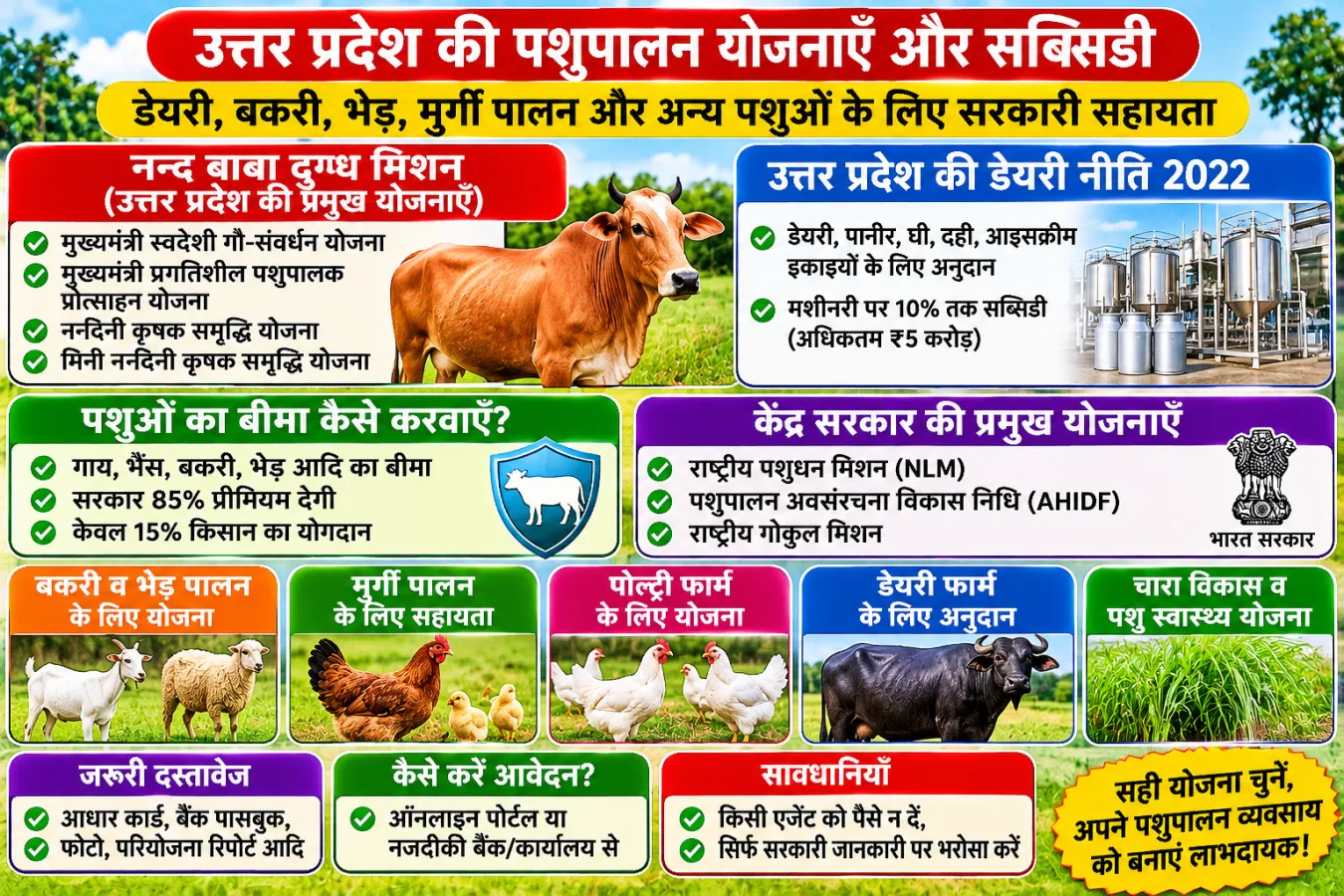
- Dairy Farming Schemes in Uttar Pradesh The Government of Uttar Pradesh has introduced several schemes under the Nand Baba Milk Mission to promote dairy farming, increase milk production, and improve market opportunities for milk producers. The mission lists four major schemes. (1) Chief Minister's Indigenous Cow Development Scheme (Mukhyamantri Swadeshi Gau-Samvardhan Yojana) The objective of this scheme is to increase the population of high-quality indigenous cows and promote breed improvement.
- Includes Gir, Sahiwal, Haryana, and Tharparkar breeds.
- The prescribed cost of a two-cow unit is ₹2 lakh.
- A subsidy of up to 40% of the project cost, amounting to ₹80,000, may be available.
- One beneficiary can receive assistance for one unit consisting of two cows.
- There is a provision to allocate 50% of the target to women milk producers.
- Insurance and ear tagging of cows are mandatory.
- Selection is carried out through online applications and an e-lottery process. This scheme is applicable in all districts of Uttar Pradesh. (2) Chief Minister's Progressive Livestock Farmer Incentive Scheme (Mukhyamantri Pragatisheel Pashupalak Protsahan Yojana) Under this scheme, livestock farmers who maintain high milk-producing indigenous cows can receive financial incentives.
- Includes Gir, Sahiwal, Tharparkar, Haryana, and Gangatiri breeds.
- Eligible farmers can receive an incentive of ₹10,000 or ₹15,000, depending on the prescribed milk production standards.
- The scheme is applicable in all districts of Uttar Pradesh.
- One livestock farmer can receive benefits for a maximum of two cows.
- Applications must be submitted within 45 days of the cow giving birth.
- The incentive amount is transferred directly to the beneficiary's bank account through Direct Benefit Transfer (DBT). (3) Nandini Krishak Samriddhi Yojana This scheme is designed for livestock farmers who want to establish a large-scale dairy farm.
- Provides support for establishing a dairy unit with 25 cows.
- Includes Sahiwal, Gir, Tharparkar, and Gangatiri breeds.
- Depending on the selected breed and project cost, the maximum subsidy may be ₹31.25 lakh or ₹30.50 lakh.
- The financial structure includes 50% government subsidy, 35% bank loan, and 15% beneficiary contribution.
- At least three years of animal husbandry experience is required.
- The prescribed land requirement includes 0.5 acres for the cattle shed and 1.5 acres for fodder cultivation.
- Insurance and ear tagging of cows are mandatory. This scheme has been listed for districts covering the headquarters of 18 divisions in Uttar Pradesh. (4) Mini Nandini Krishak Samriddhi Yojana This scheme is intended for livestock farmers who want to establish a relatively smaller dairy unit.
- Provides support for establishing a unit of 10 cows.
- The prescribed project cost is ₹23.60 lakh.
- A subsidy of 50% of the project cost, up to a maximum of ₹11.80 lakh, may be available.
- The beneficiary contribution is 15%, while the bank loan component is 35%.
- Under certain conditions, beneficiaries may also establish the unit using their own financial resources instead of a bank loan.
- There is a provision to benefit 50% women livestock farmers and milk producers.
- At least three years of animal husbandry experience is required.
- Approximately 0.20 acres of land and arrangements for year-round green fodder are required.
- Insurance and ear tagging of cows are mandatory. This scheme is listed for all districts of Uttar Pradesh.
- Uttar Pradesh Dairy Policy 2022 Uttar Pradesh Dairy Development and Dairy Product Promotion Policy The Uttar Pradesh Government's dairy policy is not limited to purchasing cows or buffaloes. It also encourages investment in milk processing, dairy product manufacturing, animal feed production, and milk storage facilities.
Major benefits include:
- Capital investment subsidy of up to 10% of eligible machinery, spare parts, and civil construction costs for new milk-processing and dairy-product manufacturing units, subject to a maximum of ₹5 crore.
- Interest-related assistance on eligible loans for new dairy-processing units, subject to a maximum of ₹10 crore.
- Eligible interest assistance for animal feed manufacturing units, subject to a maximum of ₹7.5 crore.
- Eligible interest assistance for cold-chain and milk transportation facilities, subject to a maximum of ₹1 crore.
- Electricity duty exemption or reimbursement for eligible new milk-processing units.
- Other incentives related to stamp duty and technology upgradation may also be available. Who can benefit from this policy?
- Dairy businesses.
- Paneer, ghee, curd, and ice cream manufacturing units.
- Animal feed manufacturing businesses.
- Milk chilling centres.
- Milk transportation businesses.
- Milk processing and storage facilities. These benefits are subject to investment conditions, eligibility requirements, and the applicable policy guidelines.
- How to Get Livestock Insurance Livestock farmers may face financial losses due to animal diseases, accidents, or unexpected deaths. Livestock insurance can provide financial protection against such losses, subject to the terms and conditions of the insurance policy. Livestock Insurance Scheme The following animals may be covered under eligible livestock insurance programmes:
- Cows and buffaloes.
- Goats and sheep.
- Pigs and rabbits.
- Horses, donkeys, mules, and camels.
- Other eligible breeding and working animals. Main Features of the Insurance Scheme:
- Insurance claims may be made in the event of the death of an insured animal, subject to policy conditions.
- Ear tagging is used to identify insured animals.
- A health examination may be required before insurance coverage is provided.
- Under the Central Government's NLM guidelines issued in January 2025, 85% of the eligible insurance premium is shared by the Central and State Governments, while the beneficiary contributes 15%.
- For general livestock, the subsidy limit is up to 10 cattle units per family. One cattle unit is equivalent to 10 small animals.
- Separate limits apply to pigs and rabbits. How to Get Livestock Insurance:
- Visit the nearest government veterinary hospital or Chief Veterinary Officer (CVO) office.
- Ask about the available insurance schemes and eligibility conditions.
- Get the animal's health examination completed.
- Complete the ear-tagging process.
- Follow the procedure provided by the insurance company or department.
- Pay the required beneficiary contribution towards the insurance premium.
- Keep the insurance policy and payment receipt safely. Important Note: Some government portals in Uttar Pradesh may display older insurance limits and premium rates. Before purchasing insurance, confirm the latest applicable guidelines and available insurance providers in your district.
- Major Central Government Animal Husbandry Schemes The Department of Animal Husbandry and Dairying, Government of India, lists several schemes related to dairy farming, goat farming, sheep farming, poultry, animal health, breed improvement, and livestock entrepreneurship. (1) National Livestock Mission (NLM) The National Livestock Mission aims to promote entrepreneurship in the livestock sector, improve animal breeds, and create employment opportunities.
Major Activities Covered Under the Scheme:
- Establishment of goat and sheep breeding farms.
- Establishment of rural poultry breeding farms.
- Establishment of pig breeding farms.
- Fodder production and fodder seed production.
- Silage and fodder block manufacturing units.
- Development of livestock-related businesses and employment opportunities. Subsidy:
Eligible entrepreneurship projects may receive capital investment subsidies of up to 50% of the eligible project cost. The maximum assistance depends on the type of project.
For example, eligible goat and sheep breeding projects may receive assistance of up to ₹50 lakh under the prescribed project categories.
It is important to understand that this is not a general subsidy for anyone purchasing two to four goats. Applicants must meet the prescribed requirements related to project size, business plans, bank finance, and other eligibility conditions.
Application Portal: National Livestock Mission Application Portal (2) Animal Husbandry Infrastructure Development Fund (AHIDF) The Animal Husbandry Infrastructure Development Fund aims to develop modern infrastructure and commercial facilities in the animal husbandry and dairy sectors.
Eligible Business Activities Include:
- Milk processing and value-added dairy product manufacturing.
- Meat processing units.
- Animal feed manufacturing units.
- Breed improvement and breeding farms.
- Animal vaccine and medicine manufacturing units.
- Businesses that convert animal waste into useful products.
- Eligible wool-processing units. Major Financial Benefits:
- 3% interest subvention on eligible projects.
- Bank loans and financial assistance through eligible financial institutions.
- Credit guarantee facilities, subject to applicable conditions. This scheme is not a general subsidy for purchasing one or two cows. It primarily supports the development of commercial infrastructure in the animal husbandry sector.
Official Information: AHIDF Scheme (3) Rashtriya Gokul Mission The Rashtriya Gokul Mission aims to conserve indigenous cattle and buffalo breeds, improve their genetic quality, and increase milk production.
Major Benefits and Activities:
- Conservation of indigenous breeds such as Sahiwal, Gir, and Tharparkar.
- Promotion of artificial insemination facilities.
- Use of high-quality semen and breeding bulls.
- Promotion of sex-sorted semen technology.
- Breed improvement through IVF technology.
- Awareness and training programmes for livestock farmers. Under certain components, assistance of up to 50% of the cost of sex-sorted semen and a prescribed incentive of ₹5,000 for an IVF pregnancy may be available.
Official Website: Rashtriya Gokul Mission (4) Livestock Health and Disease Control Programme (LHDCP) The objective of this programme is to protect livestock from serious and infectious diseases.
Major Activities:
- Vaccination against Foot and Mouth Disease (FMD).
- Brucellosis control programmes.
- Prevention of other infectious animal diseases.
- Disease testing and monitoring.
- Strengthening veterinary healthcare services.
- Promotion of mobile veterinary services. These activities help livestock farmers protect animal health and maintain production capacity. (5) National Programme for Dairy Development (NPDD) The National Programme for Dairy Development aims to strengthen milk collection, milk quality testing, milk chilling, and milk-processing facilities.
Major Benefits:
- Development of village-level milk collection centres.
- Establishment of milk chilling centres.
- Milk quality testing laboratories.
- Development of milk processing and value-added product facilities.
- Strengthening dairy cooperative societies and milk producer organisations.
- Connecting milk producers with organised markets. The benefits are mainly provided through eligible state dairy cooperative institutions, milk producer companies, FPOs, and institutional projects. Individual livestock farmers do not automatically receive direct cash subsidies under this programme.
Official Information: National Programme for Dairy Development (6) Support to Dairy Cooperatives and Farmer Producer Organisations (SDCFPO) This scheme aims to strengthen financially weaker dairy cooperative societies and milk producer organisations.
Major Objectives:
- Improve milk procurement and collection systems.
- Strengthen the financial position of dairy cooperatives.
- Provide better markets for milk producers.
- Improve the operational efficiency and management of milk producer organisations. The benefits are available through eligible dairy cooperative societies and Farmer Producer Organisations.
- Kisan Credit Card (KCC) for Livestock Farmers The Kisan Credit Card facility is not limited to farmers involved in crop cultivation. Eligible farmers engaged in dairy farming, animal husbandry, and fisheries can also apply for KCC facilities.
What Expenses Can Be Covered Through KCC?
- Fodder and feed for animals.
- Medicines and vaccination.
- Animal care and maintenance.
- Daily working capital requirements of dairy businesses.
- Eligible expenses related to poultry and goat farming. How to Apply:
- Visit your nearest bank branch.
- Request an application for an Animal Husbandry Kisan Credit Card.
- Submit your Aadhaar card and bank documents.
- Provide details about your livestock and animal husbandry activities.
- Complete the application according to the bank's eligibility and loan requirements. The interest rate and interest subsidy depend on the government rules applicable at the time, the loan amount, and the bank's conditions. Always confirm the current interest rate with your bank before applying.
Official Information: Animal Husbandry KCC Information 6. Goat and Sheep Farming Schemes in Uttar Pradesh Goat and sheep farming can be suitable businesses for rural areas because they can be started with relatively less space and investment compared to some large-scale livestock businesses. Goat and Sheep Breeding Units Under the National Livestock Mission Eligible entrepreneurs can establish breeding units under the prescribed project categories. Unit Category Number of Animals Maximum Prescribed Assistance Unit 1 100 females + 5 males ₹10 lakh Unit 2 200 females + 10 males ₹20 lakh Unit 3 300 females + 15 males ₹30 lakh Unit 4 400 females + 20 males ₹40 lakh Unit 5 500 females + 25 males ₹50 lakh
These are examples of the prescribed project categories. Actual eligible costs, subsidy components, and application conditions must be checked in the latest NLM guidelines.
Application Portal: National Livestock Mission Online Portal Goat and Sheep Farming Schemes in Uttar Pradesh The Uttar Pradesh Animal Husbandry Department also undertakes activities related to goat farming, sheep farming, and breed improvement.
The availability of these schemes may depend on district targets, government budgets, and application notifications issued from time to time.
Before applying, contact your district's Chief Veterinary Officer to obtain information about currently available schemes. 7. Government Assistance for Poultry Farming Government schemes also provide opportunities for entrepreneurs who want to establish commercial poultry businesses. Rural Poultry Entrepreneurship Under the National Livestock Mission Eligible entrepreneurs can establish rural poultry breeding farms under this scheme.
Major Activities:
- Establishment of low-cost rural poultry breeding farms.
- Facilities for producing chicks.
- Development of rural poultry breeds.
- Promotion of employment and business opportunities in poultry farming. The prescribed project size, technical standards, and eligible expenses apply. Simply purchasing a few chickens for ordinary poultry farming does not automatically make someone eligible for a subsidy.
- Other Government Facilities Available to Livestock Farmers Not all government assistance is provided in the form of cash subsidies. Several facilities are designed to help livestock farmers improve productivity and reduce animal healthcare expenses. Facility Benefits for Livestock Farmers Artificial Insemination Breed improvement and better production Animal Vaccination Protection against serious diseases Veterinary Health Camps Animal examination and treatment Livestock Insurance Financial protection against eligible animal deaths Fodder Development Better availability of green and nutritious fodder Animal Husbandry Training Knowledge of scientific farming methods Breed Improvement Improvement in milk, meat, and egg production Veterinary Services Treatment during illness and emergencies Dairy Cooperative Societies Market access and milk collection facilities
The Uttar Pradesh Government also undertakes activities related to animal healthcare, breed improvement, artificial insemination, and increasing the availability of green fodder. 9. Documents Required for Government Schemes The required documents may differ from one scheme to another. However, applicants should generally keep the following documents ready:
- Aadhaar Card.
- Residential Proof.
- Bank Passbook Copy.
- Passport-Size Photograph.
- Mobile Number.
- Proof of Land Ownership or Space Available for Livestock.
- Caste Certificate, if applicable.
- Animal Husbandry Project Report.
- Animal Purchase Bills, wherever required.
- Livestock Insurance and Ear Tagging Documents, wherever required.
- Training Certificate, if required by the scheme.
- Bank Loan Sanction Letter, if applicable.
- Official Websites for Government Schemes and Applications The following are important government portals where livestock farmers can obtain scheme details and application information. Department / Scheme Official Website Nand Baba Milk Mission Visit Website Uttar Pradesh Livestock Development Board Visit Website Livestock Insurance Scheme Visit Website National Livestock Mission Visit Website Department of Animal Husbandry and Dairying, Government of India Visit Website AHIDF Visit Website Rashtriya Gokul Mission Visit Website National Programme for Dairy Development Visit Website Animal Husbandry KCC Visit Website
Contact Information in Uttar Pradesh:
For assistance, livestock farmers can contact:
- Nearest Government Veterinary Hospital.
- Chief Veterinary Officer (CVO) Office.
- District Dairy Development Officer.
- Nearest Bank Branch.
- Nand Baba Milk Mission Office. Uttar Pradesh Livestock Grievance Redressal Centre Toll-Free Number: 1800-180-5141
Nand Baba Milk Mission Contact Number: 0522-4251709 11. Which Government Scheme Is Useful for Which Animal Husbandry Business? Your Business Requirement Relevant Scheme / Facility Purchasing two indigenous cows Chief Minister's Indigenous Cow Development Scheme Raising high milk-producing cows Chief Minister's Progressive Livestock Farmer Incentive Scheme Establishing a 10-cow dairy farm Mini Nandini Krishak Samriddhi Yojana Establishing a 25-cow dairy farm Nandini Krishak Samriddhi Yojana Starting a large goat or sheep farm National Livestock Mission Establishing a rural poultry breeding farm National Livestock Mission Setting up a milk-processing unit AHIDF and Uttar Pradesh Dairy Policy Starting an animal feed manufacturing factory AHIDF and Uttar Pradesh Dairy Policy Managing daily animal feed expenses Animal Husbandry Kisan Credit Card Financial protection against animal death Livestock Insurance Scheme Improving indigenous animal breeds Rashtriya Gokul Mission Animal vaccination Livestock Health and Disease Control Programme
- Important Precautions for Livestock Farmers
- Always read the official scheme guidelines before applying.
- Do not pay money to agents promising guaranteed subsidies.
- Do not confuse government subsidies with bank loans.
- Do not purchase animals before scheme approval unless the guidelines specifically allow it.
- Obtain a health certificate and purchase bill when buying animals.
- Complete insurance and ear tagging on time.
- Keep application receipts and all supporting documents safely.
- Confirm the subsidy amount, application deadline, and district target with the concerned department. Conclusion Government schemes play an important role in making animal husbandry a better and more profitable business.
In Uttar Pradesh, dairy farmers can explore schemes under the Nand Baba Milk Mission. Goat and sheep farmers can explore the National Livestock Mission. Livestock insurance can provide financial protection, while the Animal Husbandry Kisan Credit Card can help manage daily expenses. Entrepreneurs planning larger businesses can explore AHIDF and the Uttar Pradesh Dairy Policy.
Before applying for any scheme, select the right option according to your business requirements, number of animals, investment capacity, and eligibility.
Always verify the latest scheme details through the concerned government department or official portal before submitting an application.